How to Grow Onions in Containers: 25 Best Varieties and 10 Technical Truths
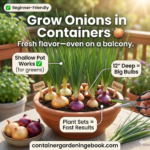
Learning how to Grow Onions in Containers is the most efficient way for urban gardeners to unlock high-density food production in limited spaces. This guide synthesizes the proven methodologies of global specialists—including plant pathologists and commercial agronomists—into a foolproof, step-by-step system. By following these technical protocols, you can transform a balcony or patio into a professional-grade allium farm.
Disclosure: This post contains affiliate links. If you use these links to buy something, I may earn a commission at no extra cost to you. This helps support the blog and keeps the garden growing!
Phase 1: Precision Variety Selection to Grow Onions in Containers
The most critical step in container onion success is matching the variety to your latitude. Onions are photoperiodic; they require a specific number of daylight hours to trigger bulb development.
-
Short-Day Varieties: Best for the Southern US (South of 36 latitude). They begin bulbing with 10 to 12 hours of light.
-
Long-Day Varieties: Essential for Northern regions (North of 36 degrees latitude), requiring 14 to 16 hours of sunlight to swell properly.
-
Intermediate/Day-Neutral: The “Safe Bet” for any location. These bulbs, with 12 to 14 hours of light, are highly recommended for beginners in transitional zones like Tennessee.
25 Best Varieties to Grow Onions in Containers
These cultivars have been selected by specialists for their reliability, uniform bulb shape, and adaptability to confined soil volumes.
-
Patterson: Renowned for long-term storage (up to 12 months) and high uniformity.
-
Candy: A versatile intermediate-day variety that is exceptionally sweet and easy for beginners.
-
Red Burgundy: A popular short-day red onion with mild flavor and beautiful color.
-
Walla Walla Sweet: A legendary long-day variety famous for its jumbo size and sweetness.
-
Ailsa Craig: A long-day Scottish heirloom that can reach massive sizes even in pots.
-
Red Baron: A reliable long-day red onion that performs well in high-density plantings.
-
White Bermuda: An extremely mild short-day variety perfect for fresh eating.
-
Super Star: An award-winning intermediate-day white onion with great disease resistance.
-
Texas Early Grano 1015Y: The gold standard for southern sweet onions.
-
Copra: A classic storage onion known for its thick skins and long shelf life.
-
Sturon: A high-yielding long-day variety with excellent resistance to bolting.
-
Red Creole: A short-day variety specifically bred for spicy flavor and good container performance.
-
Ebenezer: A dependable yellow storage onion often sold as hardy sets.
-
Crystal White Wax: Produces small, pearl-like bulbs ideal for pickling or cocktails.
-
Ishikura: A Japanese bunching onion that does not form a bulb, perfect for tight spaces.
-
Evergreen Hardy White: A perennial bunching onion that can be harvested year-round.
-
Red Long of Tropea: An intermediate-day torpedo-shaped onion with sweet, red flesh.
-
Georgia Sweet: A short-day mild variety optimized for the humid Southeast.
-
Early Yellow Globe: A long-day variety that matures quickly for northern gardeners.
-
White Spear: A fast-growing long-day variety used primarily for bunching.
-
Yellow Sweet Spanish: A massive long-day variety that thrives with consistent moisture.
-
Southern Belle: A short-day red variety with improved bolt resistance in the deep south.
-
New York Early: A dependable long-day yellow onion that cures quickly for early storage.
-
Parade: An upright bunching onion with dark green tops and refined flavor.
-
Cabernet: A medium-sized red onion with high storage potential for an intermediate-day type.
Phase 2: Setup and Vessel Design to Grow Onions in Containers
To grow onions successfully in pots, you must engineer a root environment that prevents compaction and allows for maximum bulb expansion.
Choosing Your Vessel
-
The Depth Rule: Your container must have a minimum soil depth of 10 inches.
-
Vertical Integration: For those with zero yard space, the(https://tidd.ly/4tpmxIt) is the elite choice. Its self-composting vertical design allows you to grow dozens of onions in a 2-foot footprint while providing constant nutrient flux to the root zone.
-
Fabric Grow Bags: These are preferred by experts because they facilitate “air-pruning,” which prevents roots from circling the pot and encourages a dense, fibrous root mass.
Substrate Science: The Grow Onions in Containers Potting Mix Finder
Never use heavy garden soil in containers; it will suffocate the roots. Utilize this finder tool to create the exact substrate needed for your specific crop. For a premium, ready-to-use organic option, specialists recommend(https://tidd.ly/4o0gCXp), which is peat-free and nutrient-dense.
| Target Crop | Expert Recipe Formulation | Technical Benefit |
| Onions & Alliums | 2/3 high-quality compost + 1/3 organic matter (peat/coir). Or use(https://tidd.ly/4o0gCXp). | Prevents compaction to allow maximum bulb expansion. |
| Cacti & Succulents | Equal parts loam-based soil + grit + horticultural sand. | Facilitates rapid drainage to prevent basal root rot. |
| Fruit Trees | 2 parts professional mix + 1 part peat + 1 part perlite + 1 part pumice + 1 part decomposed granite. | Provides long-term structural support for heavy roots. |
| Vegetables (General) | 1/3 compost + 1/3 coco coir + 1/3 perlite or vermiculite. | Balanced moisture retention and nutrient density. |
| Acid-Loving Crops | 2 parts peat moss + 1 part coarse perlite + 1 part fine pine mulch. | Maintains the lower pH (5.5 to 6.0) required for berries/figs. |
| Seed Starting | 2 parts screened/sterilized compost + 2 parts peat alternative + 1 part perlite + 1 part vermiculite. | Sterile and fine-textured to prevent damping off. |
Potting Mix Finder
Phase 3: Planting Strategy to Grow Onions in Containers
-
Seeds: For the widest variety of heirloom and specialized cultivars, start from seed. High-germination, organic seeds can be sourced through(https://tidd.ly/3Mpzl0Q).
-
Sets (Dormant Bulbs): This is the most reliable method for beginners. Push the tiny bulbs into the soil pointy-end up until only the tip is visible. Space them 3 to 4 inches apart. You can source robust sets and starting supplies at Perfect Plants.
-
Multisowing: To maximize space, plant 4 to 6 seeds per clump. This high-density method provides a heavier total harvest of medium-sized bulbs.
Phase 4: Maintenance for Grow Onions in Containers
Successful container onions require precise nutrient and moisture management because they have inefficient, shallow roots.
-
Step 1: Nitrogen Loading: Each leaf you grow represents a single “ring” of the bulb. To get large onions, you must maximize leaf growth early. Apply a balanced “starter” fertilizer 10-20-10 at planting. After 3 weeks, switch to a high-nitrogen source like Ammonium Sulfate 21-0-0 every 2 to 3 weeks.
-
Step 2: The “Knuckle Rule”: Check your soil daily. If it feels dry down to your first knuckle, water immediately. Containers dry out significantly faster than garden beds, so check them often.
-
Step 3: The Stop Sign: Terminate all fertilization the moment bulbing begins. You will know it has started when the soil surface begins to crack around the onion’s neck.
Phase 5: Harvesting Results When You Grow Onions in Containers
When the green tops turn yellow and naturally flop over, your harvest is ready. To prevent rot and ensure they store for months, you must “cure” them:
-
Pull the bulbs and lay them in a shaded, well-ventilated spot for 2 to 3 weeks.
-
Wait until the outer skins are uniform and the necks feel leathery and dry to the touch.
-
Clip the roots and tops, leaving 1 inch of stem to seal the bulb.
For more advanced container gardening strategies and urban homesteading deep-dives, visit our blog at containergardeningebook.com/blog.
Technical Findings on How to Grow Onions in Containers
Technical research into high-density container production has revealed several key performance benchmarks:
-
Oxygenation: Fabric containers consistently produce larger bulb diameters compared to plastic due to superior root-zone oxygenation.
-
Nutrient Efficiency: Granular fertilizers outperformed liquid feeds in bulb weight trials because the nutrients remained in the root zone longer without leaching out of the container drainage holes.
-
Pathogen Control: Using sterile soilless mixes (like(https://tidd.ly/4o0gCXp)) is the primary defense against bacterial rot in container systems where traditional crop rotation is impossible.
Leave a Reply