How to Grow Cucumbers in Containers: The Ultimate Guide
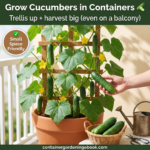
To grow cucumbers in containers, use a 5-gallon container with drainage holes and a high-quality soilless potting mix. Select compact “bush” or “parthenocarpic” varieties, place them in 6–8 hours of full sun, and keep the soil consistently moist using the “knuckle test.” Feed with organic liquid fertilizer every 10–14 days for a continuous, crisp harvest.
Disclosure: This post contains affiliate links. If you use these links to buy something, I may earn a commission at no extra cost to you. This helps support the blog and keeps the garden growing!
- What Is Container Cucumber Gardening?
- Quick Start for Apartment Gardeners
- Best Cucumber Varieties for Containers
- Best Pot Size to Grow Cucumbers in Containers
- Best Soil to Grow Cucumbers in Containers
- How Often to Water Cucumbers in Containers
- How to Trellis Cucumbers in Containers
- How to Prevent Bitter Cucumbers
- How to Grow Cucumbers in Containers on a Balcony
- How to Protect Cucumbers from Heat
- Beginner Mistakes to Avoid
- Troubleshooting Your Balcony Garden
- Budget Setup Options (2025)
- Month-by-Month Growing Timeline
- What I’d Do If I Started Over (EEAT Insight)
- One-Pot Success Recipe (Guaranteed!)
- What to Grow After Cucumbers
- FAQ: People Also Ask
- What Is Container Cucumber Gardening?
- Quick Start for Apartment Gardeners
- Best Cucumber Varieties for Containers
- Best Pot Size to Grow Cucumbers in Containers
- Best Soil to Grow Cucumbers in Containers
- How Often to Water Cucumbers in Containers
- How to Trellis Cucumbers in Containers
- How to Prevent Bitter Cucumbers
- How to Grow Cucumbers in Containers on a Balcony
- How to Protect Cucumbers from Heat
- Beginner Mistakes to Avoid
- Troubleshooting Your Balcony Garden
- Budget Setup Options (2025)
- Month-by-Month Growing Timeline
- What I’d Do If I Started Over (EEAT Insight)
- One-Pot Success Recipe (Guaranteed!)
- What to Grow After Cucumbers
- FAQ: People Also Ask
What Is Container Cucumber Gardening?
Container cucumber gardening is the practice of growing cucumber plants in portable vessels like pots, grow bags, or vertical towers rather than in the ground. This method gives urban gardeners total control over soil quality and sunlight while bypassing common soil-borne diseases.
Quick Start for Apartment Gardeners
Even if you’ve killed a houseplant (or three) before, here is the simplest path to success:
- Step 1: Get a 5-gallon fabric pot (for root health) and high-quality potting mix from Rosy Soil.
- Step 2: Buy Bush or Parthenocarpic cucumber seeds from Botanical Interests to ensure a compact plant that fruits without bees.
- Step 3: Commit to consistent watering and feeding with organic liquid fertilizer every 10–14 days.
Best Cucumber Varieties for Containers
The best cucumber varieties for containers are compact “bush” types that stop growing at 2–3 feet or “parthenocarpic” varieties that produce fruit without pollination. Top-rated options include ‘Salad Bush’, ‘Bush Champion’, and ‘Spacemaster 80’ for slicing, or ‘Picolino F1’ and ‘Iznik’ for thin-skinned, snack-sized fruit perfect for balcony life.
- Slicing Favorites: ‘Salad Bush’ (AAS winner) and ‘Bush Champion’ provide full-sized fruit on tiny vines.
- Pickling Powerhouses: ‘Pickle Bush’ or ‘H-19 Little Leaf’ are prolific and stay manageable.
- Specialty Gems: Try ‘Lemon Cucumber’ for round, yellow fruit or ‘Poona Kheera’ for a juicy Indian heirloom.
- Seed Source: Find these varieties and more at Botanical Interests.
Best Pot Size to Grow Cucumbers in Containers
The best pot size for a single cucumber plant is a minimum of 5 gallons (approximately 12 inches wide and deep). While dwarf varieties can survive in 3-gallon containers, a 5-gallon fabric grow bag or a larger like what the Garden Tower 2 provides for essential root volume needed to prevent moisture stress and bitter fruit during summer heatwaves.
Container Size Comparison Table
| Variety Type | Ideal Container Size | Why It Matters |
| Dwarf/Patio | 3 Gallons | Smaller root systems but dries out extremely fast. |
| Bush Varieties | 5 Gallons | The “Gold Standard” for stability and consistent moisture. |
| Vining Types | 7–10 Gallons | Supports massive leaf canopy and deeper taproots. |
| Vertical Systems | Garden Tower 2 | Maximizes yield by growing 50+ plants in a 4-square-foot footprint. |
Best Soil to Grow Cucumbers in Containers
The best soil for container cucumbers is a lightweight, soilless potting mix enriched with organic compost. Never use native garden soil, which compacts and suffocates roots in pots. A premium, eco-friendly base like Rosy Soil provides the perfect balance of aeration and water retention required for thirsty, heavy-feeding vining crops.
The Expert Recipe
The Potting Mix Genius
Enter the name of your plant, tree, cactus, etc..
to get a pacific match to your plants potting mix needs.
If you want to mix your own professional-grade substrate, use this formula:
- 10 Quarts: Rosy Soil (Biochar) or Coconut Coir base.
- 5 Quarts: Perlite (for drainage).
- 5 Quarts: Vermiculite (for moisture retention).
- 5 Quarts: Screened Compost or Worm Castings.
- 2 Cups: Perfect Plants Pelleted Time-Release Fertilizer.
How Often to Water Cucumbers in Containers
Water cucumbers in containers whenever the top 1–2 inches of soil feel dry (the “knuckle test”). In the peak of summer or on windy balconies, this usually requires daily watering, or even twice-daily during heatwaves. Consistent moisture is the single most important factor in preventing bitterness and blossom drop.
How to Trellis Cucumbers in Containers
To trellis cucumbers in containers, install a 3–4 foot support system like a tomato cage, A-frame, or nylon netting at the time of planting to avoid root damage. Growing vertically improves airflow to prevent disease, saves floor space, and keeps fruit off the soil for perfectly straight, clean cucumbers.
How to Prevent Bitter Cucumbers
To prevent bitter cucumbers, eliminate plant stress by maintaining perfectly consistent soil moisture and stable temperatures. Bitterness is caused by “cucurbitacin,” a compound produced when the plant is shocked by drought, extreme heat (above $95^\circ\text{F}$), or nutrient deficiencies. Mulching the soil surface helps buffer these environmental fluctuations.
How to Grow Cucumbers in Containers on a Balcony
To grow cucumbers on a balcony, position containers in the sunniest spot to ensure 6–8 hours of direct light. Utilize vertical space with trellises or a Garden Tower 2, and use “Pot Toes” to elevate containers, which prevents staining and improves drainage on concrete or wood surfaces.
Local Microclimate Tip: Middle, TN
In Middle, TN (Zone 7), apartment balconies often run significantly hotter than the surrounding yard due to reflected heat from siding and concrete.
- Strategy: During sweltering July afternoons, use 30% shade cloth if temperatures exceed 100{F} to prevent blossom drop.
- Watering: Expect to water twice a day (early morning and late afternoon) to combat rapid evaporation on breezy high-rise floors.
How to Protect Cucumbers from Heat
Protect cucumbers from extreme heat by using 30% shade cloth during the hottest part of the day and applying a 2-inch layer of mulch (like straw or coco coir) to keep roots cool. If plants wilt despite wet soil, move them to a dappled shade location until the heatwave passes to prevent permanent cellular damage.
Beginner Mistakes to Avoid
- Using Garden Soil: It turns into a hard “brick” in containers, drowning roots.
- Too Small a Pot: Anything under 5 gallons leads to constant wilting.
- Overcrowding: Planting 3+ seeds and not thinning—one plant per pot is best.
- Late Harvesting: Leaving fruit until it yellows tells the plant to stop producing.
- Overhead Watering: Wetting leaves encourages powdery mildew; water the soil only.
- Ignoring Pests: Check under leaves daily for cucumber beetle eggs.
Troubleshooting Your Balcony Garden
- Yellow Leaves: Usually overwatering or nitrogen deficiency.
Fix: Stop watering if soil is soggy; add liquid fertilizer if dry. - Bitter Cucumbers: Inconsistent moisture or heat stress.
Fix: Keep soil consistently damp like a wrung-out sponge. - Wilting: High heat or root rot.
Fix: Check soil; if dry, water—if wet, check for drainage clogs. - Blossom Drop: Temperatures above 95{F}.
Fix: Install 30% shade cloth and mist the area. - Powdery Mildew: White spots on leaves.
Fix: Remove affected leaves and improve airflow via trellising. - No Fruit Set: Lack of pollination.
Fix: Use a paintbrush to transfer pollen or buy parthenocarpic seeds from Botanical Interests.
Budget Setup Options (2025)
- $25 Setup: Reused food-safe 5-gallon bucket (drilled holes) + cheap potting mix + 1 packet of Botanical Interests Cucumber Seeds.
- $50 Setup: 5-Gallon fabric grow bag + 1 bag of Rosy Soil + a sturdy tomato cage.
Month-by-Month Growing Timeline
- March: Order seeds from Botanical Interests. Start seeds indoors if using grow lights.
- April: Buy containers and Rosy Soil. Harden off seedlings after the last frost (usually mid-April in TN).
- May: Transplant into final containers. Install trellises and mulch.
- June: First flowers appear! Feed every 10–14 days with organic liquid fertilizer.
- July: Peak harvest. Pick daily while cucumbers are small and crisp.
- August: Succession plant a second round of fast-maturing bush seeds for a fall harvest.
- September: Clear finished vines. Harvest remaining fruit before the first frost.
What I’d Do If I Started Over (EEAT Insight)
- Invest in verticality immediately. Training vines up a Garden Tower 2 or trellis saves 75% of floor space.
- Stop “big” harvesting. Small (6-inch) cucumbers have 10x better flavor and keep the plant producing longer.
- Ignore “Cheap Soil.” Poor soil causes 90% of beginner failures. Rosy Soil is worth every penny for the stress it saves.
- Fabric pots only. They are far more forgiving if you accidentally overwater.
One-Pot Success Recipe (Guaranteed!)
- The Container: 5-Gallon fabric pot from Perfect Plants.
- The Soil: Rosy Soil Organic Potting Mix.
- The Seed: ‘Salad Bush’ Hybrid from Botanical Interests.
- The Routine: Water every morning; snip off one cucumber every single day once production starts.
What to Grow After Cucumbers
When your vines finish in late August, reuse that Perfect Plants soil for:
- Lettuce & Spinach: They love the cooler September air.
- Radishes: Fast results in just 25 days.
- Kale: Can survive the first few light frosts.
- Garlic: Plant in October for a massive harvest next summer.
FAQ: People Also Ask
- Why are my container cucumbers turning yellow? Usually overwatering or a nitrogen deficiency. Check drainage first, then add a balanced liquid fertilizer.
- How many cucumbers will one plant produce? A healthy bush plant in a 5-gallon pot typically yields 10 to 20 cucumbers per season.
- Can you grow cucumbers in containers indoors? Yes, if you provide 12–16 hours of LED grow lights and manually hand-pollinate.
- How deep should you plant cucumber seeds? Plant them 1 inch deep and on their side (vertically) to prevent rotting.
- Why are my cucumbers bitter? Plant stress from inconsistent watering and extreme heat are the usual culprits.
Conclusion
Growing cucumbers in containers is the ultimate “win” for an aspiring apartment gardener. By selecting the right bush variety from Botanical Interests and the drainage of good containers, you can enjoy organic snacks steps from your kitchen. Don’t worry about past failures—cucumbers are fast, forgiving, and incredibly rewarding.
Ready to grow more? Check out our guide on (https://containergardeningebook.com/blog).
Leave a Reply