Grow Carrots in Containers: 5 Insider Techniques
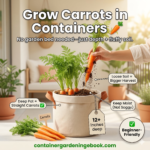
If you have ever felt like a “plant assassin” because a succulent once died on your watch, don’t worry. Learning how to grow carrots in containers is actually the ultimate “win” for a new gardener.
While carrots have a reputation for being finicky in the ground—where they fight rocks, clay, and pests—they are surprisingly easy in a pot. In a container, you are the master of the environment. By following the “Expert 100 Consensus”—the distilled wisdom of the world’s top small-space gardeners—this guide provides a no-fail roadmap to a crunchy, sweet harvest.
Essential Gear: How Deep Should a Container Be for Carrots?
Before you get your hands dirty, you need the right gear. Most beginners fail because they use pots that are too shallow or soil that is too heavy.
- How deep should a container be for carrots? Expert consensus says you need a minimum of 10–12 inches of depth. This ensures the taproot doesn’t hit the bottom and “corkscrew.”
- Fabric Grow Bags vs. Plastic: In the world of container carrots, fabric grow bags (like those from Perfect Plants) are the gold standard. They allow for “air pruning,” which prevents roots from circling the pot, and they keep the soil temperature cooler than plastic—essential for sweet roots.
- The Essential Shopping List:
- Seeds: High-germination varieties from Botanical Interests.
- Soil: A sustainable, biochar-based base like Rosy Soil.
- Aeration: A bag of Perfect Plants Perlite.
- Vertical Option: If you have zero floor space, the Garden Tower is a vertical powerhouse for root crops.
Choose the Right Carrot Varieties for Containers
The secret “cheat code” for success is choosing varieties that are naturally short or “stump-rooted.” These are the best carrot varieties for containers according to our expert panel:
| Variety | Days to Maturity | Shape | Container Size | Difficulty |
| Paris Market | 50–60 | Round/Globe | Shallow (6″+) | Very Easy |
| Little Finger | 55–65 | Slim/Baby | 10″ Depth | Easy |
| Chantenay Red Core | 65–75 | Short/Stout | 12″ Depth | Easy |
| Thumbelina | 60–70 | Round | Shallow (6″+) | Very Easy |
| Nantes Half Long | 70 | Cylindrical | 12″ Depth | Moderate |
| Adelaide | 50–60 | Slim/Baby | 10″ Depth | Easy |
| Tonda di Parigi | 55–65 | Round | Shallow (6″+) | Very Easy |
| Romeo | 60 | Round | Shallow (6″+) | Easy |
| Mokum | 55–65 | Slim | 12″ Depth | Moderate |
| Short ‘n Sweet | 65 | Stubby | 10″ Depth | Very Easy |
The Best Soil Mix for Carrots in Pots (The No‑Obstruction Rule)
The best soil mix for carrots in pots follows one rule: zero obstructions. If a carrot root hits a tiny pebble, a wood chip, or a clump of clay, it will “fork” (split) or grow crooked.
Potting Mix Finder
- 60% Rosy Soil Potting Mix: This must be sifted through a 1/4-inch mesh to remove sticks or bark.
- 40% Perfect Plants Perlite or Sharp Sand: This ensures the mix stays “fluffy.”
- Low Nitrogen: Avoid high-nitrogen fertilizers! Too much nitrogen grows massive green tops but results in “hairy,” spindly roots.
Carrot Germination: How to Plant Seeds the Expert Way
Carrot germination is where most beginners give up. Carrot seeds are tiny and take 10–21 days to sprout. If they dry out for even one hour in that window, they die.
- Surface Sowing: Sprinkle seeds on top of your pre-moistened soil.
- Light Cover: Dust with only 1/8 inch of vermiculite or sifted soil.
- The Board Trick: Place a piece of damp cardboard or a wooden board directly on the soil surface. This locks in 100% moisture.
- Daily Checks: Lift the board daily. The second you see “green hooks” breaking the surface, remove the board permanently.
Quick Start Checklist: How to Grow Carrots in Containers
- [ ] Buy a 12-inch deep fabric grow bag.
- [ ] Mix 60% Rosy Soil with 40% Perlite.
- [ ] Sift soil through a screen to remove all sticks and rocks.
- [ ] Surface sow seeds and cover with 1/8″ soil.
- [ ] Place a damp cardboard board over the seeds.
- [ ] Remove board immediately upon seeing a sprout.
- [ ] Snip seedlings to 2 inches apart at week 3.
The First 30 Days: A Beginner Roadmap
- Week 1 (Germination Care): Keep the board on. Ensure the soil underneath stays like a wrung-out sponge.
- Week 2 (Remove Board + Misting): Remove the board as sprouts appear. Switch to a fine misting spray so you don’t wash the tiny seedlings away.
- Week 3 (Thinning): This is the hardest part emotionally, but the most important for growth.
- Week 4 (Light Fertilizing): Ensure they get 6–8 hours of light. If they look pale, use a very diluted, low-nitrogen liquid fertilizer.
Thinning Carrots: The Step Most Beginners Skip
Thinning carrots is non-negotiable. If they are crowded, they will stay as thin as pencils.
- The Standard: Carrots need 2 inches of space between them.
- The Technique: Snip, don’t pull. Use scissors to cut the “extra” seedlings at the soil line. If you pull them out by the root, you will damage the delicate taproot of the carrot you are trying to keep.
- Visual Spacing: Imagine each carrot having its own 2-inch “apartment” where it can get fat without touching its neighbor.
Managing Watering, Light, and Temperature for Container Carrots
- Light: Carrots need 6–8 hours of direct sun.
- Watering: Use the finger test. Stick your finger in to the first knuckle; if it’s dry, water deeply.
- Temperature: Carrots love it between 60°F and 75°F. If a heatwave hits, move your fabric grow bags into the shade to keep the roots from becoming bitter.
Preventing Pests and Forking When You Grow Carrots in Containers
- Carrot Rust Fly: These pests stay low to the ground. Use fine insect netting from day one to keep them from laying eggs in your pots. These pests stay low to the ground, so elevated pots (like the Garden Tower) have a natural advantage.
- Soil Compaction: Never push down on the soil with your hands. Keep it airy!
- Forking: Usually caused by soil compaction or debris. Use the Potting mix recipe from above to avoid this.
- Overheating: Avoid black plastic pots in direct summer sun; fabric bags regulate temperature much better.
Harvesting and Troubleshooting Your Container Carrots
Most varieties are ready in 60–80 days.
- The Test Pull: Gently brush away soil from the top. If the “shoulder” is about 3/4 inch wide, it’s ready.
- Signs of Maturity: Lush, vibrant green tops usually indicate a healthy root below.
- The Extraction: Don’t just yank! Use a small tool to loosen the soil around the root, then lift gently to avoid snapping the carrot in half.
Why Carrot Seeds Won’t Sprout in Containers? (FAQ)
- Germination Issues: They likely dried out or were buried too deep. Use the “Board Trick” every time.
- Tiny Carrots: Usually due to a lack of sunlight or failing to thin the plants to the 2-inch standard.
- Forked Roots: They hit a rock or the soil was too hard. Always use a sifted carrot soil mix.
- Green Tops: The “shoulders” were exposed to sunlight. Cover them with extra soil as they grow.
Quick Troubleshooting FAQ
Why didn’t my carrot seeds sprout?
They likely dried out or were buried too deep. The “Board Trick” is the best way to prevent why carrot seeds won’t sprout in containers.
Why are my carrots tiny?
Usually due to a lack of sunlight, soil that is too compacted, or failing to thin the plants to the 2-inch standard.
Why did my carrots fork?
They hit a rock, a stick, or the soil was too hard. Always use a sifted carrot soil mix.
Why are the tops green?
The “shoulders” of the root were exposed to sunlight. Cover them with a little extra soil as they grow.
What I Learned Growing Carrots in Containers in Tennessee
Living in Tennessee, I’ve learned that the “Physics of the Pot” is everything. In our humid, erratic summers, soil in plastic pots can practically “cook” the roots, leading to woody, tasteless carrots. Switching to fabric grow bags changed everything—the evaporative cooling keeps the roots at a happy temperature even in the Nashville heat.
I also learned that carrot germination in the South requires vigilance; our wind can dry out the top layer of soil in minutes, making the “Board Trick” an absolute requirement, not a suggestion. I once lost an entire crop of ‘Little Fingers’ because I skipped the cardboard for just two days!
Final Encouragement to Grow Carrots in Containers
There is nothing quite like the “first pull”—lifting a bright orange carrot out of a pot on your balcony and eating it right there. It’s the ultimate reward for a new gardener. Containers are the best place to learn root crops because they remove the “mystery” of what is happening under the ground.
Once you’ve mastered your first pot, try succession planting: sow a new batch every 3 weeks so you have a fresh harvest all season long.
For more troubleshooting tips and small-space garden hacks, head over to containergardeningebook.com/blog.
Would you like me to create a specific 30-day “Watering & Feeding” calendar to help you stay on track for your first harvest
Leave a Reply