17 High-Yield Balcony Garden Ideas to Grow $500 of Food in 4 Sq. Ft.
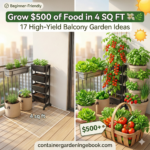
If you’ve ever walked onto your apartment patio and seen a graveyard of plastic pots and shriveled herbs, you aren’t alone. Most beginners think they have a “black thumb,” but the truth is usually much simpler: they are trying to garden in a 400-square-foot apartment using rules designed for a 40-acre farm.
Disclosure: This post contains affiliate links. If you use these links to buy something, I may earn a commission at no extra cost to you. This helps support the blog and keeps the garden growing!
In 2026, the cost of organic produce is higher than ever, but your balcony garden shouldn’t be a money pit. You can actually harvest $500 worth of groceries in a tiny footprint if you stop thinking horizontally and start thinking like a structural engineer. This guide is your blueprint to turning a small urban space into a high-production food factory. I highly recommend the Garden Tower II for this, but not needed.
Why a Small Balcony Garden Outperforms a Backyard
It sounds contrarian, but a well-managed balcony garden can actually yield more food per square foot than a traditional backyard plot. In a backyard, you are fighting weeds, rabbits, and poor native soil. In a container-based system, you have 100% control over the environment.
You control the soil, the drainage, and the nutrient density. Because your plants are elevated, they are safe from ground-dwelling pests. When you optimize the root zone in your balcony garden, you trigger a growth response that traditional gardeners rarely see. By concentrating your efforts on 4 square feet, using the Garden Tower II, you ensure that every single plant is performing at its peak.
The $500 Yield Blueprint: The 4-Square-Foot Layout
To hit high-profit numbers, you cannot just line up pots along the railing. That is a waste of space. To maximize a balcony garden, you must utilize the vertical plane.
The Vertical Stacking Strategy
The most successful urban farmers use a vertical stacking system or a composting garden tower, like the Garden Tower II. This allows you to grow up to 50 plants in the footprint of a single doormat.
- The Base: Heavy-duty 5-gallon pots for “heavy feeders” like tomatoes or peppers.
- The Middle Tiers: Pockets for leafy greens, kale, and spinach.
- The Upper Tiers: Shallow-root herbs like cilantro, parsley, and chives.
- The Railing: Hanging planters for “spiller” crops like strawberries or trailing rosemary.
Sun Path Requirements:
- Path A (Full Sun – 6+ Hours): Best for fruiting crops (Tomatoes, Peppers).
- Path B (Partial Sun – 3-5 Hours): Best for greens and herbs.
High-Yield Crop List: Real Numbers & Dollar Values
To reach that $500 goal, your balcony garden needs to focus on high-value crops. You don’t grow potatoes (which are cheap at the store); you grow gourmet greens and fresh herbs.
| Crop | Container Size | Days to Harvest | Annual Yield (Est.) | Store Value (Organic) |
| Gourmet Salad Mix | 4″ Depth Tier | 25–40 Days | 25 lbs | $200 ($8/lb) |
| Fresh Basil/Cilantro | 6″ Pocket | 21 Days (ongoing) | 30 Bunches | $120 ($4/bunch) |
| Cherry Tomatoes | 5 Gallon (Base) | 70 Days | 15 lbs | $75 ($5/lb) |
| Kale/Swiss Chard | 8″ Pocket | 45 Days (ongoing) | 20 Bunches | $80 ($4/bunch) |
| Arugula | Stacking Tray | 20 Days | 10 lbs | $60 ($6/lb) |
| TOTAL | $535 |
The Yield Formula
To track your ROI, use this simple calculation:
$$Total \ Savings = (Harvest \ Weight \times Local \ Organic \ Price) – Startup \ Cost$$
Most people find that their balcony garden pays for itself within the first 90 days.
🛠 Interactive Tool: Potting Mix Finder
Don’t use “dirt” from the ground. It’s full of pathogens and too heavy for containers. Your results depend entirely on soil aeration and drainage. Use the tool below to find the exact ratio for your specific plants.
Enter the name of your plant, tree, cactus, etc.. to get a pacific match to your plants potting mix needs.The Potting Mix Genius
The “Success System” Shopping List
To hit these numbers, you need professional-grade inputs. Avoid the “sacrificial” plants at the supermarket and the cheap, heavy soil bags at the gas station.
- The Soil (The Lungs): I recommend Rosy Soil. It’s a carbon-negative, biochar-based mix specifically engineered to prevent the compaction and fungus gnats that plague many an indoor balcony garden.
- The Seeds (The DNA): For high germination rates and high yield, go with Botanical Interests. Their seeds are tested for reliability, and their packaging contains a wealth of growing info.
- The Plants (The Fast-Track): If you want to skip the “seedling anxiety,” buy established, healthy plants from Perfect Plants. They ship directly to your door, ensuring your garden is “productive” from day one.
8 Common Beginner Mistakes to Avoid
- Using “Garden Soil”: It’s too heavy and suffocates the root system.
- Overwatering: If the soil stays swampy, roots can’t breathe. Always use the “finger test” before watering.
- Ignoring the Wind: High-rise wind can desiccate a plant in hours. Use windbreaks or moisture-retention soil like Rosy Soil.
- Wrong Pot Size: Crowding your plants leads to stunted growth and low yields.
- Cheap Seeds: Poor seeds waste your time and soil. Stick with Botanical Interests.
- Forgetting to Fertilize: Containers leach nutrients every time it rains or you water. Use a liquid organic fertilizer every two weeks.
- Harvest Hesitation: Leafy greens like lettuce and kale actually grow more the more you pick them.
- Poor Light Assessment: Trying to grow tomatoes in the shade is a recipe for heartbreak. Know your sun hours before you plant.
Mastering Your Microclimate
Your balcony isn’t just a space; it’s a microclimate. Because of the concrete and glass, it acts as a “heat island,” often staying 5-10°F warmer than the ground level.
- Wind Management: If you are on a high floor, the wind is your biggest enemy. Place sensitive herbs like basil behind larger, sturdier plants or use the railing as a natural windbreak.
- Reflected Heat: Glass doors can reflect the sun and double the heat intensity. Use “pot feet” to lift containers off the floor to prevent the roots from cooking on the hot concrete.
- The Southern Strategy: In warm, humid climates like the Southeast, airflow is critical. Don’t overcrowd your balcony garden pockets, or you’ll invite powdery mildew.
The One-Hour Weekend Routine
You don’t need to spend all day gardening. A successful balcony garden thrives on a simple, consistent schedule.
- Saturday Morning (20 Mins): Check moisture levels and do a “deep soak” if the soil is dry to the second knuckle.
- Saturday Morning (20 Mins): Prune and “deadhead.” Remove any yellowing leaves-they are energy vampires that slow down production.
- Saturday Morning (20 Mins): Harvest. Pick everything that is ready to eat. This signals the plant to produce more.
4-Square-Foot Crop Rotation Plan
Soil health is vital when you are growing intensively.
- Season 1 (Spring): Nitrogen Fixers. Plant peas or beans from Botanical Interests to prep the soil.
- Season 2 (Summer): Heavy Feeders. This is when you put your Perfect Plants tomatoes or peppers into that nitrogen-rich soil.
- Season 3 (Fall): Light Feeders. Finish the year with leafy greens in Rosy Soil.
If you’re serious about hitting that $500 harvest goal but don’t want to turn your balcony into a cluttered graveyard of 50 individual pots, the Garden Tower 2 is the ultimate “cheat code” for urban growers.
Think of it as a vertical food factory that allows you to grow up to 50 organic plants in just 4 square feet of floor space-essentially the footprint of a doormat. Because it turns 360 degrees, you can easily chase every minute of sunlight, making it the perfect solution for those tricky, shaded balconies where traditional pots usually fail.
The real genius, however, is the internal vermicomposting tube that runs right down the center. You simply drop your kitchen scraps into the tower, and the worms turn that waste into “black gold” fertilizer that feeds your plants automatically from the inside out.
This self-fertilizing system, combined with the tower’s massive soil volume, provides the critical thermal mass needed to protect sensitive roots from the extreme balcony heat that usually cooks plants in smaller, cheap containers. It’s the closest thing to “autopilot” gardening available today and the foundational piece for any truly high-yield balcony garden, or patio. , etc..
Balcony Garden Efficiency: Traditional vs. Vertical
| Feature | Traditional Individual Pots | Garden Tower 2 (Vertical) |
| Plant Capacity | 1–2 plants per pot | Up to 50 plants |
| Floor Space Used | 15+ Sq. Ft. (Cluttered) | 4 Sq. Ft. (Footprint of a doormat) |
| Watering Time | High (Watering 20+ separate pots) | Minimal (One central watering point) |
| Fertilizer Cost | Constant (Buying bottled nutrients) | $0 (Integrated Vermicomposting) |
| Root Protection | Low (Roots “cook” in small pots) | High (Massive soil volume insulates) |
| Total Annual Yield | ~$50–$100 | $500+ |
| Recommended Setup | Generic Pots + Rosy Soil | Garden Tower 2 + Rosy Soil |
Why the Garden Tower Wins for Urban Growers
The math doesn’t lie. In a traditional balcony garden, you are limited by the edges of your pots. In a vertical system, you are utilizing the “free” air space above your balcony. When you combine the Garden Tower 2 with professional-grade Rosy Soil and high-quality transplants from Perfect Plants, you remove the two biggest killers of urban gardens: root dehydration and nutrient depletion.
If you are ready to stop “trying” to garden and start actually harvesting, the choice is clear.
Click here to get the Garden Tower 2 and start your high-yield journey today.
Troubleshooting Table: Common Problems & Fixes
| Symptom | Probable Cause | The Fix |
| Yellow Bottom Leaves | Nitrogen Deficiency | Add organic liquid fertilizer immediately. |
| Wilted Leaves (Wet Soil) | Root Rot | Stop watering; improve drainage holes. |
| Tiny White Webs | Spider Mites | Increase humidity and spray with neem oil. |
| Stretched/Leggy Stems | Lack of Sunlight | Move to a sunnier spot or add a grow light. |
| Black Flies (Gnats) | Soil is too wet | Let the top inch dry; switch to a biochar-based mix. |
Safety & Weight Limits
A common fear is that a balcony garden will be too heavy for the structure. Standard residential balconies are rated for 40-60 lbs per square foot.
- Lightweight Materials: Use resin or fabric pots rather than heavy ceramic.
- Weight Distribution: Place your heaviest systems (like a vertical tower) against the building’s structural wall, not right up against the outer railing.
Real-World Case Study: “Apartment Amy”
Amy lived in a 12th-floor condo with a small 5×5 balcony. She started with 10 random pots but was frustrated by low yields. She switched to a vertical stacking system using Rosy Soil and started with healthy transplants from Perfect Plants. By focusing on gourmet arugula and fresh basil, she reduced her grocery bill by $45 a month. By the end of the season, she had harvested $420 worth of organic produce, proving that a balcony garden isn’t just a hobby-it’s a high-yield investment.
What to Do With Your Harvest
Don’t let your hard work go to waste.
- Herbs: Dry your excess herbs or freeze them in olive oil in ice cube trays.
- Greens: If you harvest too much kale, make kale chips or blanch and freeze for smoothies.
- Tomatoes: Small cherry tomatoes can be slow-roasted in the oven with garlic and stored in jars.
High-Intent FAQ
Q: Can I grow food on a north-facing balcony?
A: Yes, but you must focus on greens like spinach and kale. Fruiting plants will likely fail without 6 hours of sun.
Q: How do I manage pests without chemicals?
A: Use “Companion Planting.” Planting marigolds and chives in your balcony garden deters many pests naturally.
Q: Is it cheaper to grow my own food?
A: If you focus on high-value items (herbs and greens), your balcony garden pays for itself in one season.
Next Steps for Your Garden
- Step 1: Measure your sun path this weekend.
- Step 2: Order your vertical system and Rosy Soil.
- Step 3: [Read our guide on the best organic fertilizers for containers].
- Step 4: [Learn how to start seeds indoors with Botanical Interests].
Ready to expand? Learn more about container gardening by visiting our blog at (https://containergardeningebook.com/blog).
Leave a Reply