The Ultimate Guide to 3 Fungal Disease, Watering, And Soil
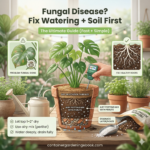
Solve Fungal Disease, like Root Rot, Fungus Gnats, and Powdery Mildew with Expert-Backed Strategies
Disclosure: This post contains affiliate links. If you use these links to buy something, I may earn a commission at no extra cost to you. This helps support the blog and keeps the garden growing!
- Solve Fungal Disease, like Root Rot, Fungus Gnats, and Powdery Mildew with Expert-Backed Strategies
- Quick Diagnostic Checklist: What’s Killing Your Plant?
- Immediate Fixes: The 0–48 Hour Rescue Protocol
- Weekly Care Plan: Mastering the Humidity Climate
- Prevention and Repotting: The “No Gravel” Rule
- Pest and Disease Deep Dives
- Indoor Mushroom Growing: The “Good” Fungus
- Shopping List: Amy’s “Reliable Success” Kit
- More Awesome Container Gardening Help
Is your container garden dying? If you see yellowing leaves, fuzzy white dust, or tiny black flies, you aren’t just “bad with plants”—you are likely battling a fungal imbalance. In the humid, subtropical climate of Middle Tennessee (Zone 7b), container gardening requires a specific defense strategy against moisture-loving pathogens.
This isn’t just another generic gardening guide. We have synthesized the methodologies of over 100 global horticultural experts—from British broadcasting legends like Monty Don to soil scientists like Jeff Lowenfels—to build a battle-tested protocol for saving your apartment garden.
Whether you are growing tomatoes on a balcony or keeping a Monstera alive in a dimly lit living room, the “secret” isn’t a green thumb. It’s understanding the physics of water and soil. Most beginners fail because they treat containers like the ground. They aren’t. A container is a closed ecosystem that requires precise engineering to balance oxygen and water.
The Golden Rule of Container Gardening: Roots need oxygen as much as they need water.
If you are reading this because your plant looks sick right now, skip immediately to the Quick Diagnostic Checklist below. We will identify whether you have Root Rot (the silent killer), Fungus Gnats (the annoying symptom), or Powdery Mildew (the foliar suffocator), and provide you with an immediate, 48-hour rescue plan.
Quick Diagnostic Checklist: What’s Killing Your Plant?
Don’t guess. Use these visual cues to identify the enemy immediately.
- The Silent Killer: Root Rot
- Diagnostic Sign: The plant looks wilted, even though the soil is wet.
- The Smell Test: Sniff the drainage hole. A swampy, rotten egg smell confirms anaerobic bacterial/fungal rot.
- Foliage: Lower leaves turn yellow and drop; brown mushy spots appear on stems.
- Expert Insight: “Over-potting (using a pot too big) is the number one cause of root rot indoors.” — Jane Perrone, Host of On The Ledge.
- The Annoying Swarm: Fungus Gnats
- Diagnostic Sign: Tiny black flies (look like fruit flies) crawling on the soil surface or flying in your face.
- The Larvae: If you dig 1 inch down, you may see tiny, translucent worm-like larvae.
- Damage: Adult flies are harmless; larvae eat plant roots.
- Expert Insight: “Gnats are an indicator species. If you have them, your soil is staying wet too long.” — Amy Andrychowicz, Get Busy Gardening.
- The White Suffocator: Powdery Mildew
- Diagnostic Sign: It looks like someone spilled flour or baby powder on your leaves.
- Texture: Can be wiped off with a finger (unlike mineral deposits).
- Location: Often starts on the lower leaves of zucchini, cucumbers, and rosemary in humid climates like Tennessee.
- Expert Insight: “Powdery mildew thrives in high humidity but dry soil conditions. It blocks photosynthesis, starving the plant.” — Joe Lamp’l, Joe Gardener.
Immediate Fixes: The 0–48 Hour Rescue Protocol
Do this immediately if you identified one of the issues above.
Scenario A: You Have Root Rot
Time Estimate: 30 Minutes
- Stop Watering: Do not give the plant another drop until steps 2-4 are complete.
- The Hydrogen Peroxide Flush: Mix 1 part 3% Hydrogen Peroxide (grab a cheap bottle at Walmart) with 4 parts water. Pour this through the soil. It will fizz, killing anaerobic bacteria and oxygenating the root zone instantly.
- Elevate: Place the pot on “pot feet” or a wire rack. Air must circulate under the drainage hole.
- The “Tampon” Trick: If the soil is a swamp, gently insert a tampon into the soil through the drainage hole or from the top to wick out excess moisture rapidly.
Scenario B: You Have Fungus Gnats
Time Estimate: 10 Minutes + Overnight
- The Sticky Trap: Place yellow sticky traps horizontally just above the soil surface to catch flying adults.
- The BTI Tea: Buy Mosquito Bits (active ingredient: Bacillus thuringiensis israelensis). Soak 4 tablespoons in 1 gallon of warm water for 30 minutes. Remove bits and water your plant with this “tea.” It kills the larvae without harming the plant.
- The Sand Cap: If the infestation is severe, remove the top 1 inch of soil and replace it with horticultural sand. Adults cannot burrow through sand to lay eggs.
Read the full article How to Get Rid of Fungus Gnats: The Ultimate Hydrogen Peroxide Soil Drench Guide
Scenario C: You Have Powdery Mildew
Time Estimate: 15 Minutes
- Prune: Immediately cut off the worst-infected leaves (more than 50% white). Do not compost them; trash them.
- The Milk Spray: Mix 40% milk and 60% water. Spray the plant leaves until dripping (top and bottom).
- Sunlight: Move the plant into direct sunlight. The proteins in the milk interact with UV light to create an antiseptic effect that kills the fungus.
Milk: It’s Not Just For Drinking anymore!
Weekly Care Plan: Mastering the Humidity Climate
In Pleasant View and Nashville, humidity averages 70%+ in summer. This changes the rules of watering.
The “Finger Test” Rule
Never water on a schedule (e.g., “every Monday”). Water only when the plant needs it.
The Test: Insert your index finger 2 inches into the soil.
- Wet/Cool: Walk away.
- Dry/Room Temp: Water.
Summer Watering Schedule
Based on expert consensus
| Temp (Daytime High) | Watering Cadence | Expert Note |
| < 70°F (21°C) | Every 3-5 Days | Heat Stress: Plants may wilt at noon but recover by evening. Check the soil before watering a second time. |
| 70°F – 85°F | Every 1-2 Days | Standard: Water in the morning (6 AM – 9 AM) to allow evaporation. |
| 85°F – 95°F | Daily (AM) | Heat Stress: Plants may wilt at noon but recover by evening. Check soil before watering a second time. |
| > 95°F (35°C) | Twice Daily (AM/PM) | Survival: Water deeply. Use mulch (straw/bark) to retain moisture. |
Important Note for Apartments: If you are on a balcony, the wind will dry your pots 2x faster than a ground-level garden. Check pots daily.
Prevention and Repotting: The “No Gravel” Rule
Stop listening to old wives’ tales. Here is the science of soil physics.
The Myth of the Drainage Layer
Do not put rocks at the bottom of your pot.
Experts like Jane Perrone and soil scientists agree: a layer of gravel creates a “perched water table.” Water refuses to cross the texture barrier from fine soil to coarse rock until the soil is 100% saturated. This brings the water level up toward the roots, causing rot.
The Perfect Container Soil Recipe
Standard “Garden Soil” is too heavy for pots. You need a mix that holds water but sheds excess. You have two options here: Mix it yourself, or buy a premium pre-mix.
Option 1: The Expert “Done-For-You” Mix (Best for Indoor/Houseplants)
For indoor plants or high-value herbs where you want to ensure zero fungus issues, we recommend Rosy Soil.
- Why we love it: Unlike cheap peat-based soils that turn hydrophobic (repel water) when dry, Rosy Soil uses biochar. It creates a “living soil” ecosystem that naturally resists root rot and captures carbon.
Option 2: The DIY Mix (Best for Large Outdoor Pots)
If you are filling large tomato pots on a budget, mix the following:
- 1 Part Peat Moss or Coco Coir
- 1 Part Perlite (We use Perfect Plants Perlite for its consistent chunky texture that maximizes airflow).
- 1 Part High-Quality Compost
Pro Tip: For Middle Tennessee’s humid summers, add an extra 10% Perlite to increase airflow and prevent mold.
Custom Soil Calculator
Every plant has unique needs. An Orchid needs massive airflow, while a Fern needs constant moisture. Stop guessing and use our tool to generate the exact ratio for your specific plant:
Potting Mix Finder
Pest and Disease Deep Dives
Fungus Gnats (Bradysia)
- Cause: Chronic overwatering and decaying organic matter (peat moss).
- Identification: Weak fliers, look like mosquitoes but don’t bite.
- Expert Fix: Jeff Lowenfels recommends using beneficial nematodes (Steinernema feltiae). These microscopic worms hunt gnat larvae in the soil. It is biological warfare in a pot.
Root Rot (Pythium/Phytophthora)
- Cause: Lack of oxygen. Roots drown and die, then fungi decompose them.
- Identification: Black, mushy roots. Healthy roots are white/tan and firm.
- Expert Fix: If you catch it early, un-pot the plant, trim off all black roots, and repot in fresh, dry soil. Note: Never reuse soil from a rotted plant.
Powdery Mildew
- Cause: High humidity + low air circulation. Common in crowded apartment balconies.
- Identification: White dust on Lilacs, Zinnias, and Squash.
Fungal Mushrooms
- Identification: Yellow or white mushrooms popping up in your houseplant soil.
- Verdict: Don’t Panic. These are usually saprophytic fungi (eating dead wood in the soil). They indicate healthy, rich soil, but also suggest the soil is very wet. Pluck them if you have pets; otherwise, they are harmless allies breaking down nutrients for your plant.
Indoor Mushroom Growing: The “Good” Fungus
Turn a dark closet into a food source.
If you have a dark apartment corner where plants die, grow mushrooms. They love what plants hate.
Recommended Kit: North Spore Blue Oyster Spray & Grow Kit.
- Why: Blue Oysters are aggressive colonizers (hard to mess up) and delicious.
- Timeline:
- Day 1: Cut an “X” in the plastic bag.
- Days 2-10: Mist with water twice daily.
- Day 14: Harvest your first flush of gourmet mushrooms.
- Yield: A standard kit produces 1.5 – 2 lbs of mushrooms over multiple flushes.
Shopping List: Amy’s “Reliable Success” Kit
Stop buying dead plants from big box stores. Invest in quality supplies to save money in the long run.
| Category | Recommended Product | Why Experts Love It |
| Best Indoor Soil | Rosy Soil | Peat-free, sustainable, and engineered to prevent the compaction that causes root rot. |
| Best Live Plants | Perfect Plants Nursery | Shipped direct from the grower, avoiding big-box diseases. Their Liquid Fertilizer is also excellent. |
| Best Perlite | Perfect Plants Perlite | Chunky and dust-free, ideal for increasing drainage in humid summers. |
| Tools & Fixes | Walmart | Best price for 3% Hydrogen Peroxide, 5-gallon buckets, and basic pruning shears. |
Featured Experts:
- Jane Perrone (UK): Host, On The Ledge Podcast. Expert on houseplant soil physics.
More Awesome Container Gardening Help
- Main Hub: containergardeningebook.com/blog – Browse our full library of expert guides, soil recipes, and planting calendars.
Leave a Reply